

 Benjamin
 A domain in an auction list says it is 18 years old. The current site has three thin pages, and the Wayback Machine first saw this version last spring. The age looks impressive until the timeline appears.
So which date is real?
Both can be. A domain name has a registration history, while the website on that name has a publishing history. Those timelines often overlap, but they answer different questions.
When I check age for SEO, link prospecting, or an expired-domain purchase, I want to know how long the site was visibly active, what it published, and whether that activity continued. The number of years alone tells me very little.
The two meanings of domain age
Registration age
Registration age begins with the creation date reported by a registry through RDAP or WHOIS. RDAP is the structured registration-data protocol that has replaced much of the old WHOIS lookup process. This date tells me how long the current registration record has existed.
It does not prove that a working website existed for that entire period. A name can remain parked, redirect elsewhere, sit unused, or change owners several times. If a domain expires and is later registered again, the visible creation date may also reset, depending on the registry and the way the drop occurred.
Archive age
Archive age starts with the earliest known capture of the website in a public web archive, usually the Wayback Machine. It answers a more practical question: when did crawlers first see content on this domain?
The first capture is evidence of an existing site, though it is rarely the exact launch date. Archives miss pages, some sites block crawlers, and early coverage can be sparse. I read it as the earliest available proof, not a birth certificate.
The last capture matters too. A site first archived 15 years ago and last captured eight years ago has an old history, but it may also have a long inactive period. That gap changes the risk.
Why age alone does not create SEO value
Domain age is not a direct Google ranking factor. An older name can have SEO assets that accumulated over time: backlinks, branded searches, indexed content, citations, and a recognizable entity. Age is the container. Those assets are the contents.
A new domain can outrank an older one with better pages, stronger links, clearer search intent, and sound technical SEO. An old domain can carry years of spam, hacked pages, irrelevant redirects, or link schemes.
That is why I avoid statements such as “older domains rank faster.” Sometimes an established history helps a project start with useful signals. Sometimes the history becomes the problem I have to clean up.
What I look for in an archive timeline
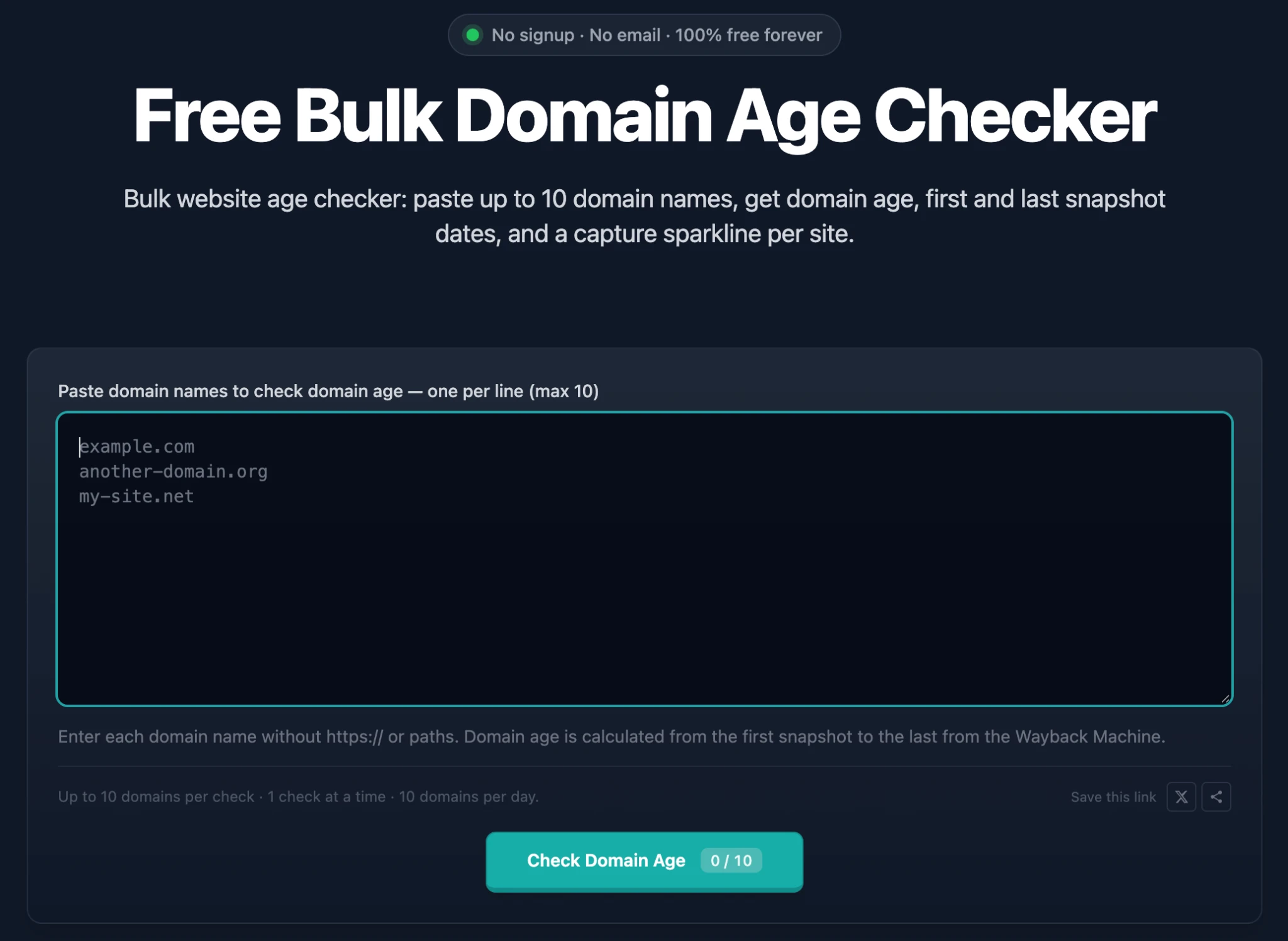
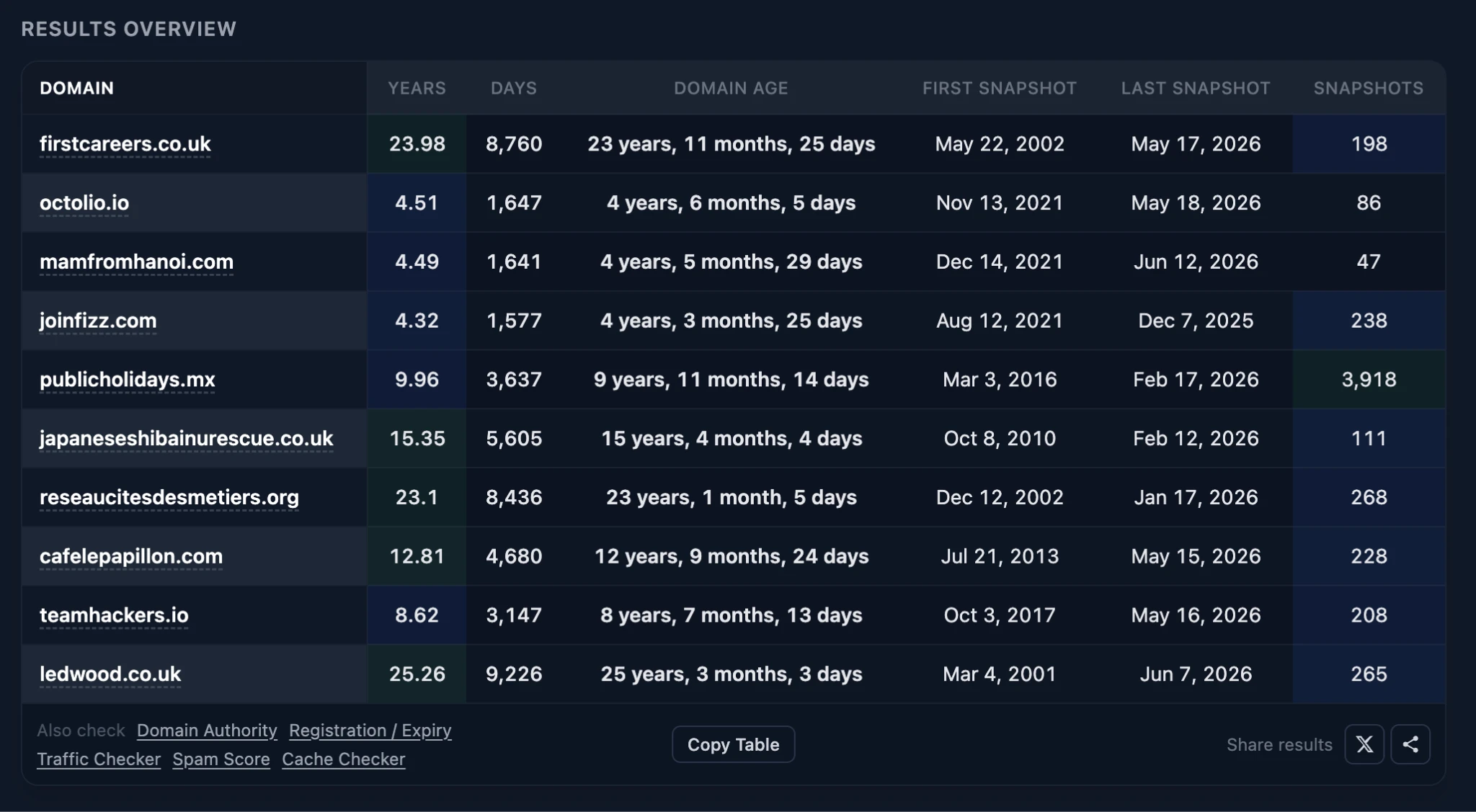
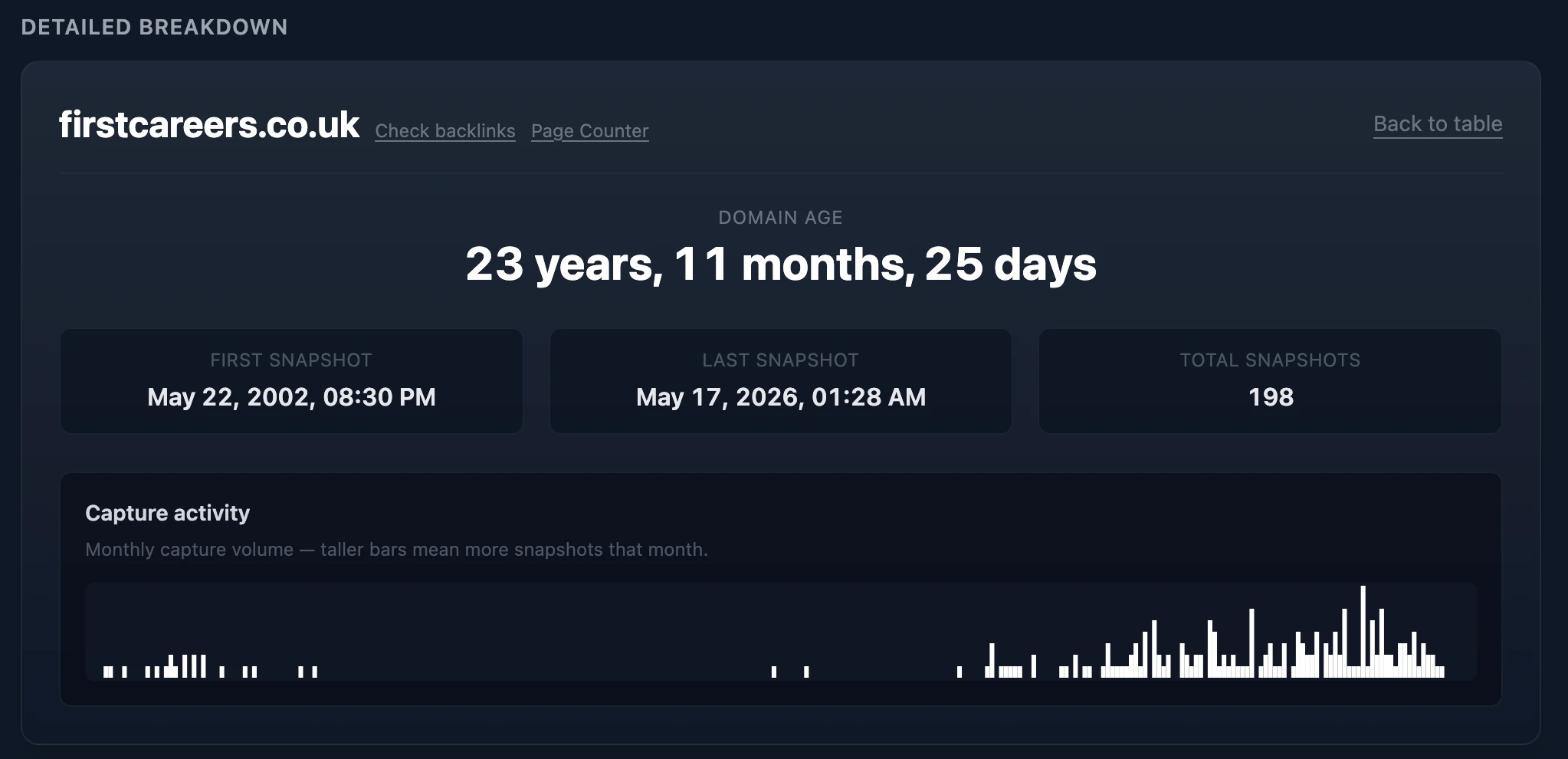
For a working shortlist, I use the free bulk Domain Age Checker to compare the first capture, last capture, total snapshots, and monthly activity across several domains. The sparkline is useful because it turns a long list of archive dates into a visible pattern.
For larger shortlists, the Karma.Domains Expired Domains API and MCP can return the same age and archive fields to a script, spreadsheet or AI agent before I open each candidate.
A steady capture pattern
Regular captures across many years usually mean the site stayed accessible and published enough material to attract crawlers. It does not guarantee quality. It does give me a reason to inspect the content and links in more detail.
A long empty period
A multi-year gap can point to parking, downtime, crawler blocking, or a dropped domain. I sample snapshots on both sides of the gap. If the subject, language, design, and ownership clues all change at once, I treat the domain as a new project using an old name.
A sudden burst of captures
A sharp spike can be normal during a redesign or publishing push. It can also reveal mass-generated pages, faceted URLs, or a hacked section. Faceted URLs are filter combinations that create many crawlable page variants, common on stores and directories.
I open several snapshots from the spike rather than judging the bar height. The pages explain the pattern.
An old first capture with a recent last capture
This is the shape many buyers hope to see: long web history and recent activity. I still check whether the topic remained stable. A continuous capture line can hide a complete switch from a local business to gambling, crypto, or a generic affiliate site.
My six-step domain-age check
1. Put registration and archive dates on one line
I record the registry creation date, first archive capture, last archive capture, and the date of the current site version when I can establish it. This simple timeline prevents me from calling a parked 20-year-old name a 20-year-old website.
2. Measure the gaps
I look at the gap between registration and first capture, then the gap between the last capture and the present site. A short first gap suggests the domain was used soon after registration. A long one may indicate parking or missing archive coverage.
The second gap tells me whether the old project flowed into the current one. I do not set a universal cutoff. A seasonal business may have irregular captures, while a daily publisher should leave a much denser trail.
3. Sample transition years
Opening the first and latest snapshots is a start. The ownership and topic changes usually sit in the middle.
I sample at least one capture from the early period, one before a major gap, one after it, and one from the most recent active period. For a costly domain, I add more samples around every visible spike or break.
4. Track topic, language, and business-model changes
I write down what the site was: local company, SaaS product, blog, directory, store, parked page, or something else. Then I note the main language and country.
Topic drift means the domain gradually or suddenly moved into another subject. A gardening blog that became a betting review site has severe drift. The old backlinks may still exist, yet their topical relationship to the current content has vanished.
5. Match the history to the backlink profile
Backlinks should make sense for the archived site. If the archive shows a small dental clinic but the strongest links come from software roundups and foreign-language casino pages, I investigate anchor text and redirect history.
Anchor text is the clickable wording used in a link. Commercial anchors repeated at scale, such as exact product or betting terms, can reveal a previous SEO campaign that the age number never shows.
6. Check what can actually be rebuilt
For an expired-domain project, I map strong incoming links to their old destination URLs. Link equity is the ranking value a link may pass. It is easier to preserve when the new site can publish a genuinely relevant replacement page at the same URL or a closely related destination.
If the valuable links point to pages from an unrelated former business, the domain may be old and strong on paper while offering little usable foundation for the planned site.
How I use domain age in different SEO jobs
Expired-domain research
Age is a fast shortlist filter here, never an approval rule. Once a candidate shows a meaningful archive history, I open Karma.Domains for domain history research and check archived topics, anchor text, backlinks, spam signals, and continuity before I decide whether the name deserves a deeper review.
For PBN work, the standard should be even stricter. A PBN, or private blog network, uses controlled sites to place links. Obvious topic switches, copied rebuilds, and aggressive anchor patterns create footprints that can make the whole setup fragile.
Guest-post and link-prospect screening
A long, stable archive can support the case that a publisher is real. I compare that history with recent posts, organic visibility, editorial quality, and outbound-link behavior. If the site became a paid-post warehouse last year, its earlier history does not rescue the current placement.
Competitor research
Archive age helps me understand when a competitor began publishing, when it changed positioning, and which content era attracted links. I can then compare the early site structure with the pages that now receive traffic.
This is especially useful when a competitor appears to have grown quickly. The current brand may be new while the domain, links, and content library came from an earlier project.
Client and acquisition due diligence
For an agency audit or website acquisition, I use the timeline to challenge claims about longevity. A footer that says “since 2008” proves nothing by itself. Registry and archive evidence can show whether the domain, the website, and the present business share that history.
Patterns that deserve a manual review
- The registration date is old, but the first archive capture is recent.
- The archive is active for years, then goes silent before a completely different site appears.
- Capture volume jumps at the same time the site adds thousands of thin or foreign-language pages.
- The historical topic and the strongest backlink anchors do not match.
- The last meaningful capture is several years old, although the domain is being marketed as an active aged asset.
- An archived brand changes while the legal, contact, and location details disappear.
Any one of these can have an innocent explanation. Together, they form a due-diligence queue.
Who needs this check
I would add an archive-age check to the routine of an SEO beginner evaluating links, an outreach specialist qualifying publishers, an agency reviewing a new client, a domain investor pricing a name, or an affiliate team building on expired assets.
The check is quick. The buying decision may be expensive.
The date I trust
I do not choose between registration age and archive age. I put them together, mark the gaps, and verify what happened during those gaps.
An old registration tells me the name has existed. A continuous, relevant archive shows me that a real website built a history worth examining.


 How to Choose the Right AI Video Generator: Model and Use Case Analysis
  How to Choose the Right GenAI Partner for Your Business in 2026
  Practical Strategies for Building Reliable Network Security in a Cloud-First World
  DeepSeek R1: The AI Revolution That Defied U.S. Trade Barriers and Stunned the World
  Why Some AI Models Fail Under Pressure – A DeepSeek AI Case Study
  Various Ways to Sell Bitcoin for Cash Instantly